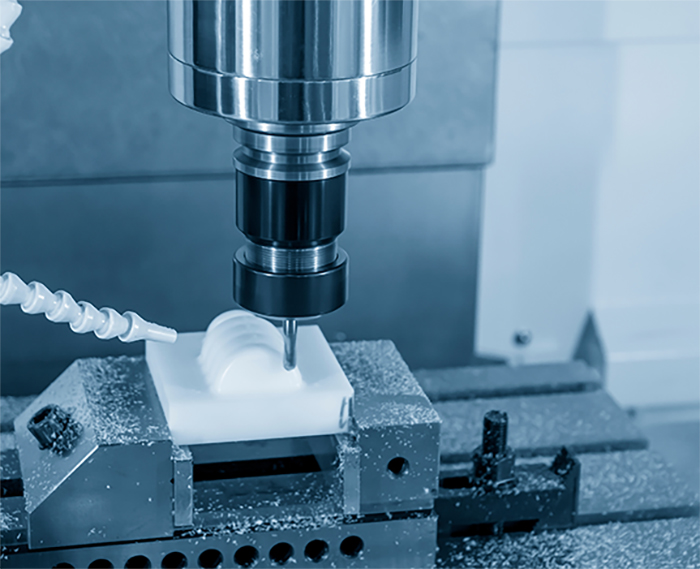
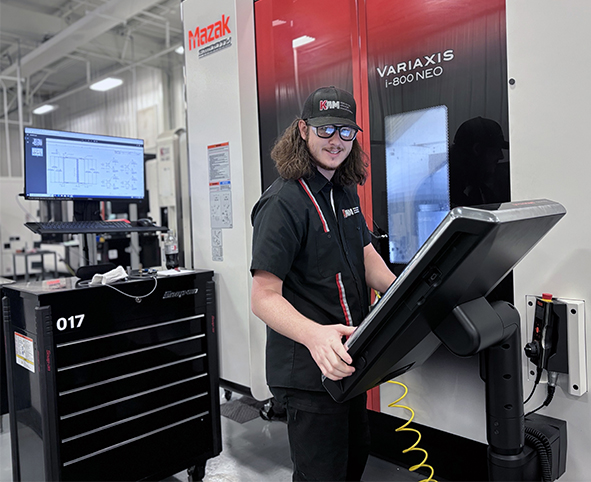
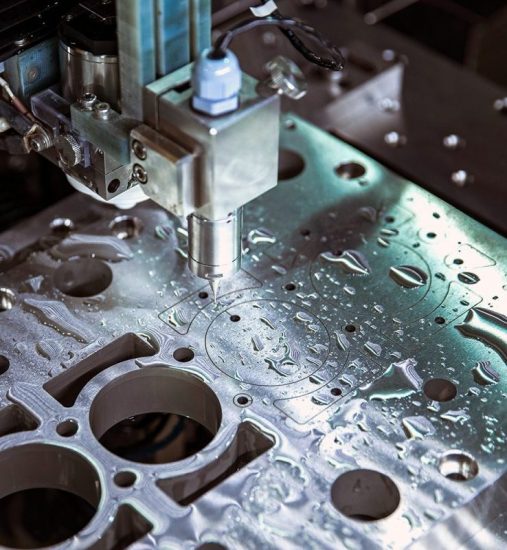
Our advanced milling capabilities empower industries to produce complex geometries, achieve tight tolerances, and scale production seamlessly—all while maintaining the highest quality standards.
CNC Milling

Achieving Injection-Molded Quality
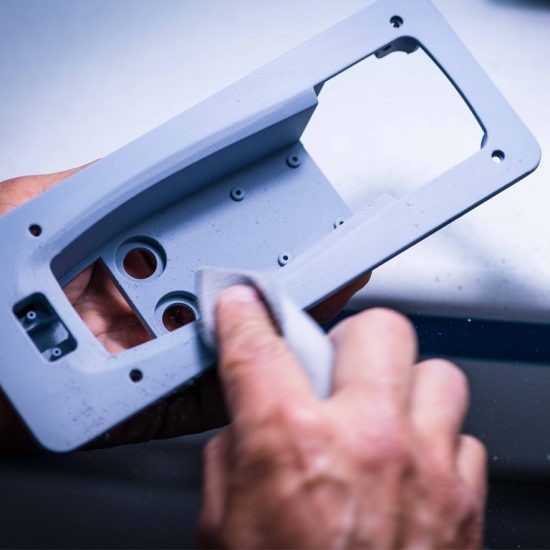
While 3D printing excels at creating complex geometries and customized designs, it often requires further refinement to meet the exacting standards of end-use applications. Through precision CNC machining, we enhance the surface smoothness, dimensional accuracy, and overall aesthetics of polymer parts, ensuring they meet or exceed injection-molding standards.
- Surface Perfection: Achieve smooth, uniform finishes free of layer lines or inconsistencies.
- Tight Tolerances: Our machining processes maintain tolerances down to ±0.001 inches, ensuring parts fit seamlessly into your assemblies.
- Material Versatility: From medical-grade polymers to high-performance engineering plastics, we refine a wide range of materials for critical applications.

Advanced Equipment
Our facilities are equipped with advanced 3-, 4-, and 5-axis CNC milling machines, enabling the production of intricate parts with exceptional accuracy for prototypes and large-scale production runs. We consistently achieve tight tolerances to ensure every component meets or exceeds specifications.
- Extensive Equipment: Over 65 CNC mills and lathes capable of tolerances as tight as 0.00005″.
- Ultra-Precision Machining: Micron-level accuracy with tolerances of ±0.001 inches.
- Quality Assurance: Comprehensive inspections with CMMs and 3D scanning to ensure conformance.
- Rigorous Quality Control: Consistent, high-standard output across all production scales.
- Industry-Ready Solutions: Delivering components tailored for critical applications across various industries.
CNC Milling Operations
Our CNC milling centers perform a wide range of precision machining operations to create complex features and high-accuracy components, including:
-
Face Milling – creating flat, smooth surfaces with precise thickness control
-
End Milling – machining slots, profiles, and detailed features
-
Pocketing – removing material to form internal cavities and recessed areas
-
Contouring – producing complex 2D and 3D geometries and curved surfaces
-
Drilling & Tapping – creating accurate holes and threaded features
- Multi-Axis Machining (3-Axis to 7-Axis) – supporting highly complex geometries and multi-surface features with fewer setups, improved accuracy, and reduced lead times
|
|
Finishing
Our Dedicated Precision CNC Facilities
ADDMAN’s CNC turning capabilities support critical applications across aerospace, defense, medical device, and industrial markets. Our specialized facilities are equipped to meet the precision, quality, and compliance requirements of each industry.
What is CNC Milling?
CNC mills are automated cutting machines equipped with a rotating spindle head designed to remove unwanted material with precision. Available in various sizes and axis configurations, these machines are versatile and capable of machining a wide range of materials, from plastics and aluminum to stainless steel and titanium. While commonly used for harder metals, CNC milling is adaptable to diverse manufacturing needs.
How CNC Milling Works
CNC milling relies on G-Code, a set of instructions generated by CAM software, to control the machine’s movements and operations. The G-Code dictates:
- Tool head positioning and movement.
- Spindle speed and cutting depth.
- Feed rates and workpiece adjustments.
The complexity of G-Code corresponds to the number of axes the milling machine operates, with advanced multi-axis mills capable of creating intricate geometries.
CNC Milling vs. CNC Routing
While CNC mills are ideal for profile cutting harder materials, CNC routers are better suited for softer materials like wood and plastics. Key differences include:
- Workpiece Movement: CNC routers keep the workpiece stationary, moving the cutting head around it. CNC mills move both the tool head and, in some cases, the workpiece itself.
- Applications: CNC milling is primarily used for industrial-scale manufacturing, while CNC routers are favored for smaller-scale production, such as woodworking and sign-making.
CNC mills excel in precision, making them the go-to solution for industrial applications where accuracy and material versatility are paramount.