
Engineers know how to move heat. The harder question is often whether the geometry they need to do it can actually be manufactured.
Across aerospace, defense electronics, power systems and other high-performance applications, engineers are being asked to dissipate more heat while working within increasingly constrained envelopes for size, weight and available space. Thermal performance can no longer be treated as an afterthought. In many systems, it is one of the constraints that determines what the system can do in the first place.
But there is another constraint that has shaped thermal management hardware for decades: how the component can be manufactured.
Traditional cold plates and heat exchangers rely on machined housings, drilled or extruded channels, brazed fin stacks and multi-piece assemblies. These are proven manufacturing methods, but they inherently limit the geometries available to thermal designers. Internal passages need tool access. Features must accommodate fixturing. Complex internal structures may require multiple components and joining operations.
Laser Powder Bed Fusion (LPBF) changes that equation. Instead of asking how to machine the geometry required to manage heat, engineers can begin with a different question:
What geometry would manage the heat most effectively?
Designing For the Thermal Problem
Because LPBF builds metal components layer by layer, internal geometry no longer has to be dictated by cutting-tool access.
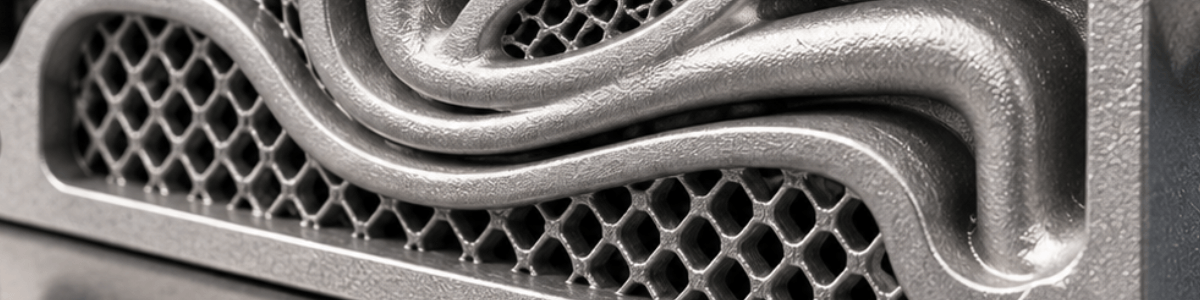
Conformal channels can follow the shape of the component and direct coolant toward localized heat loads. Flow paths can branch and merge. Lattice structures can dramatically increase the wetted surface area inside a compact volume. Manifolds, mounting features, sensor ports and other features can be integrated into the same component rather than manufactured separately and assembled later.
That freedom creates opportunities well beyond simply producing a more complicated cold plate.
It allows thermal management hardware to be designed around the thermal map of the system itself.
Instead of routing coolant where manufacturing permits, flow can be concentrated where heat generation is greatest. Instead of relying exclusively on straight channels or conventional fin structures, engineers can evaluate architectures such as diagonal offset fins or triply periodic minimal surface (TPMS) structures to increase surface area and influence flow behavior.
And because structural and fluid-handling features can be consolidated into a single build, additive manufacturing can also reduce the number of individual components and joints in an assembly.
For pressure-bearing thermal hardware, that can mean something particularly valuable: fewer interfaces that can become leak paths.
Complexity Is Only Useful When It Solves the Right Problem
The ability to manufacture complex geometry does not mean every thermal component should become geometrically complex.
Effective thermal design still requires balancing heat transfer, pressure drop, flow distribution, structural requirements, weight, manufacturability and cost.
A dense lattice may provide tremendous surface area, for example, but internal surface roughness can increase hydraulic resistance. Highly complex internal channels also create challenges for powder removal, inspection and cleanliness. Thin-walled structures require careful management of residual stress and distortion during manufacturing.
That is why Design for Additive Manufacturing (DfAM) matters.
For thermal applications, DfAM isn’t simply taking a conventionally manufactured cold plate and printing it instead. The component has to be considered as an integrated thermal, fluid, structural and manufacturing system.
Channel geometry, build orientation, powder evacuation, minimum feature size and post-processing requirements all influence the final design. Thermal and computational fluid dynamics modeling can be used before manufacturing to evaluate pressure drop, velocity distribution and thermal resistance, while structural analysis can assess pressure requirements and manufacturing-induced stresses.
The objective isn’t complexity.
The objective is performance.
The Print Is Not the Finished Part
Thermal management also illustrates something important about production additive manufacturing: printing is only one step in the manufacturing process.
After LPBF, thermal hardware may require stress relief, heat treatment, Hot Isostatic Pressing (HIP), CNC machining, surface finishing, cleaning and inspection before it is ready for service. Critical sealing surfaces, ports and mounting datums may require precision machining. Internal channels must be cleared of residual powder and verified for cleanliness. Depending on the application, surface finishing can also be used to improve internal channel conditions and reduce pressure losses.
For mission-critical hardware, inspection and validation continue beyond dimensional verification.
Internal geometry can be evaluated using CT scanning. Pressure-bearing components can undergo proof-pressure and leak testing. Hydraulic testing can compare actual pressure drop and flow distribution against design predictions, while thermal testing validates performance under representative heat loads and flow conditions.
This is where the conversation moves from “Can we print this?” to “Can we repeatedly manufacture a component that performs as intended?”
And that distinction matters as additive manufacturing moves from development into production.
Where Thermal Management Meets Advanced Manufacturing
The opportunity for LPBF thermal management is especially compelling where conventional manufacturing begins to collide with demanding system requirements.
In aerospace and defense electronics, for example, thermal hardware may need to manage concentrated heat loads while simultaneously minimizing size and weight. Additively manufactured cold plates can place conformal cooling directly beneath high-dissipation areas while integrating structural and mounting features into the same component.
Similar challenges exist in power electronics and high-heat-flux industrial systems, where increasing power density can push conventional thermal architectures toward their practical limits.
The advantage of additive manufacturing in these applications isn’t simply that it can create geometry that looks different.
It is that manufacturing becomes less of a constraint on the geometry engineers can use to solve the thermal problem.
From Design Freedom to Production Confidence
At ADDMAN, thermal management brings together capabilities across the manufacturing lifecycle: DfAM and engineering, LPBF production, heat treatment and post-processing, precision CNC finishing, inspection and validation. The goal is not simply to produce an intricate internal geometry, but to carry that design from development into repeatable hardware.
That distinction becomes increasingly important as advanced manufacturing moves beyond proving what is possible.
The next generation of thermal hardware will require more than design freedom. It will require manufacturers capable of translating that freedom into controlled, inspectable and repeatable production.
Because ultimately, the most sophisticated thermal design in the world only matters if you can manufacture it reliably.