
Additive manufacturing can create geometry that would be difficult — or impossible — to manufacture conventionally. But eventually, the build finishes. And the part still has to work.
Critical surfaces may need to be machined. Holes finished. Interfaces brought into tolerance. Features located relative to as-printed geometry. The component may need heat treatment, inspection, testing and finishing before it ever reaches its final application.
For production hardware, getting the part off the build plate isn’t the end of the manufacturing problem. In many ways, it’s the beginning of a new one.
Machining an additively manufactured part isn’t the same as machining a billet. Understanding the difference can determine whether complex printed geometry successfully becomes a repeatable production component.
The Print Is the Starting Condition
With billet, machinists begin with something valuable: material.
There is stock available to establish orientation, create workholding and machine the component into its final geometry. The starting condition is also highly predictable.
Castings, forgings and extrusions offer less flexibility, but decades of mature manufacturing processes have made their starting conditions relatively well understood.
Printed parts are different.
Metal additive manufacturing can produce components extremely close to their final geometry. That’s one of its greatest advantages — but it also means the machinist has less material available to compensate for variation downstream. Printed components can exhibit more geometric variation from part to part than traditional starting stock.
That changes the machining problem.
Fixtures may need to accommodate variation. Programs may require different strategies. And the person standing at the machine needs to understand not only the geometry they’re trying to create, but the geometry they’re actually starting with.
At ADDMAN, that has led to a much tighter connection between additive manufacturing, machining and inspection.
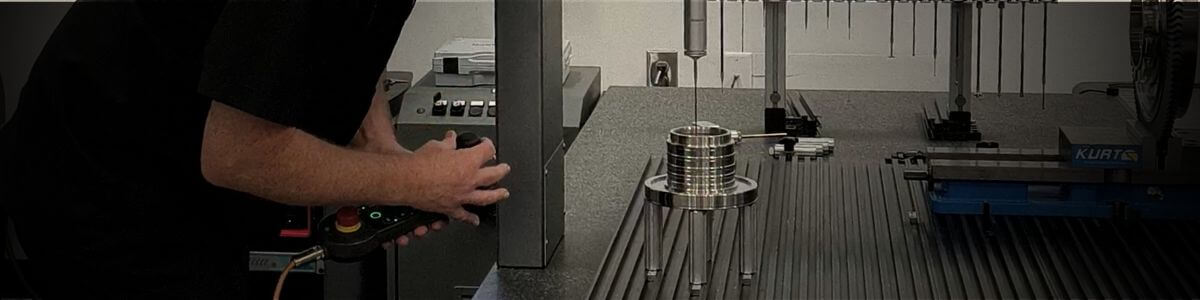
Blue-light scanning can help establish where material actually exists on a printed component. CMM data can help determine how that part should be positioned and best-fit within machining fixtures. And when printing and machining teams work together upstream, workholding and machining strategy can be considered before the build ever begins.
The objective isn’t to force every printed part into a machining process designed for billet.
It’s to build the machining process around the actual starting condition.
Every Setup Is Another Opportunity for Variation
Machining complexity isn’t only about how difficult a feature is to cut.
It’s also about how many times the component has to move.
Consider a part requiring machining on all six sides.
On a 3-axis machine, that could require six or seven separate setups. Each time the component is removed, repositioned and located again, another opportunity for setup variation enters the process.
With 5-axis machining, that same component may require only two setups while allowing critical features to remain coordinated more effectively. And when milling and turning capabilities are combined within the same equipment, work that once moved from a mill to a lathe and back can stay within fewer setups.
That’s why increasingly sophisticated machining equipment matters to additive production.
Not because more axes are inherently better, but because fewer setups mean fewer opportunities to introduce error into an already complex manufacturing process.
It’s also why ADDMAN’s continued investment in multi-axis machining and automation is centered on more than capacity.
Palletization allows multiple parts and setups to be prepared offline. Probing can establish setup conditions at the machine. In-process feature checks can provide additional information while the component is being machined.
Together, those capabilities help create a more repeatable production process around parts that may not arrive at the machine in exactly the same condition every time.
Precision Is a System, Not a Machine Specification
It’s easy to describe precision machining with a tolerance. The harder question is what it takes to repeatedly achieve it.
ADDMAN teams are producing machined features at tolerances of ±0.0005 inches or less, including positional requirements of 0.001 inches or less relative to as-printed features on complex components.
That capability doesn’t come from purchasing a machine capable of holding a particular number. It requires the entire manufacturing system to support it.
→ The equipment has to be capable.
→ The machinist has to understand the process.
→ Engineering has to develop the right programming and tooling strategy.
→ Probing has to establish and monitor critical conditions.
→ Inspection has to validate that the process continues to produce the intended result from part to part.
When a tight requirement appears on a drawing, it starts a chain of decisions: Which equipment can hold it? How should the component be programmed? How should it be tooled and fixtured? What technologies should be used during machining? And how will the resulting feature be inspected?
Precision isn’t a number a machine produces. It’s the result of a manufacturing process designed to produce that number repeatedly.
The Best Machining Solution Might Not Be a Machining Solution
Some of the most difficult manufacturing problems arrive after another supplier has already struggled to solve them. Sometimes, the reason ADDMAN finds a path forward is that the team doesn’t limit the solution to the process where the problem first appeared.
A difficult machining requirement may ultimately require a different tooling strategy. It could involve EDM. It could require a change to datum structures so a feature can actually be inspected. It might require engineering changes to improve manufacturability while maintaining the original design intent.
In some cases, the answer can extend all the way upstream to material selection or the overall manufacturing route. ADDMAN teams have helped rethink processes involving casting, forging, welding and final precision machining when the original path created production challenges. That’s the difference between solving a machining problem and solving a manufacturing problem.
The first asks:
How do we machine this?
The second asks:
What has to happen for this part to be produced successfully?
Those aren’t always the same question.
The Fewer Boundaries, the Faster the Feedback Loop
That distinction becomes especially important when additive and machining are separated across multiple suppliers.
Imagine the chain.
One organization prints the component. Another machines it. Another handles inspection. Other specialized processes may happen somewhere else again.
Every handoff creates another boundary across which requirements, schedules, data and manufacturing feedback have to travel.
If the machinist discovers that the printed starting condition creates a workholding problem, that information has to move back upstream.
If additive needs to modify something to improve the downstream process, the feedback has to travel the other direction.
When the core processes live within the same manufacturing organization, that loop can become dramatically shorter.
For ADDMAN, controlling the path from powder to printed component to finish-machined part allows additive engineers and machining teams to respond directly to what they’re seeing in production. Workholding can change. Parameters can be adjusted. Inspection data can inform machining strategy. Lessons from one production cycle can feed directly into the next.
That matters for quality. It matters for schedule. And as development programs accelerate toward production, it matters for risk.
Integration doesn’t eliminate manufacturing risk, but it reduces the number of organizational boundaries across which that risk has to be managed.
Additive and Subtractive Aren’t Competitors
For years, additive manufacturing has often been discussed in terms of what conventional manufacturing it could replace.
That’s increasingly the wrong question.
Additive manufacturing gives engineers access to geometry and material placement that conventional processes may not allow. Precision machining creates the interfaces, tolerances and finished features that allow that geometry to function in the real world. Inspection tells us whether the process actually delivered what was intended. Automation helps make that process more repeatable and scalable.
And the feedback between all of them makes the next part better.
The most capable manufacturing strategies recognize what each process does best — and connect them early enough that each can inform the next.
Print it. Machine it. Inspect it. Qualify it.
When those processes operate as a connected manufacturing system, what happens after the print can inform what happens before the next one. Inspection data can improve machining strategy. Machining experience can influence workholding and print decisions. Problems can be addressed closer to where they occur, and what the team learns from one component can strengthen the process for the next.
That’s how complex geometry becomes repeatable production hardware.
And that’s where additive manufacturing becomes manufacturing.