
HexPEKK® combines exceptional strength-to-weight performance, thermal and chemical resistance, and industry-leading qualification data to accelerate aerospace and defense applications. In this on-demand webinar, experts from ADDMAN and NIAR explain how B-basis allowables help reduce risk, streamline certification, and unlock new design possibilities.
Applications for HexPEKK® Additive Manufacturing
HexPEKK® is being used across aerospace, defense, and advanced industrial applications where lightweight performance, thermal stability, and complex geometries are critical requirements.
Common applications include:
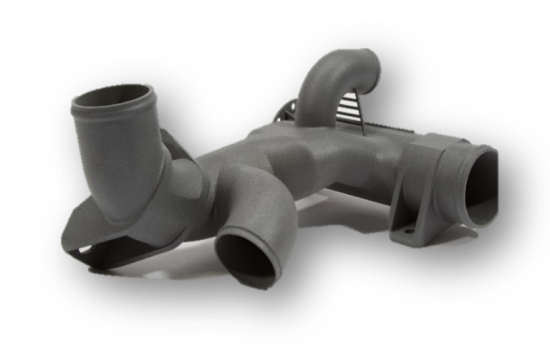
Aerospace Ducting Systems
Create lightweight, complex airflow management systems that would be difficult or impossible to manufacture using traditional methods.
Structural Brackets & MountsReplace metal components with lightweight polymer alternatives while maintaining strength and durability requirements. Electronic Housings & EnclosuresLeverage the material’s electrostatic dissipative (ESD) properties to protect sensitive electronics in demanding environments. Thermal Management ComponentsDesign optimized airflow pathways and cooling structures capable of operating in elevated temperature environments. |
 |
Space & Defense Systems
Utilize flight-proven material performance for mission-critical applications where reliability and weight reduction directly impact system performance.
Through additive manufacturing, engineers can consolidate multiple components into a single part, reduce assembly complexity, and accelerate production schedules.
| Feature | Metric | Imperial |
|---|---|---|
| Max Part Size (L×W×H) | 616 × 318 × 527 mm | 24.25 × 12.5 × 20.75 in |
| Min Wall Thickness | 2.032 mm | 0.08 in |
| Min Hole Diameter | 2 mm | 0.08 in |
| Thickness Tolerance | +0.5 / -0.25 mm | +0.02 / -0.01 in |
| Surface Profile Tolerance | 2 × (0.0075 × Part Max + 1) mm | 2 × (0.0075 × Part Max + 0.04) in |
| Typical Surface Roughness (Finished) | <12.5 Ra µm | — |
| Typical Surface Roughness (Unfinished) | — | <500 Ra µm |
Welcome everyone to HexPEKK In Focus. Appreciate you taking the time to join the ADDMAN group today to discuss this high performance polymer. A little bit of housekeeping before we get started. We turned everyone’s camera and microphone off, but we do encourage that you put your chats in the question box, and we have a dedicated Q&A session at the end where we’ll go through anything that the group has to ask. A recording will be sent out after we conclude the webinar, and you can look at that in the future. And again, the ADDMAN team is available for any questions you may have.
What we’re going to be covering today in this session. We’re going to hit on why B-basis data matters and how it accelerates certification. We have a great guest speaker here to talk through this whole process for you guys. We’ll run through HexPEXXs proven performance in some mission critical environments and then also share some real world applications of the technology.
I’d like to introduce a couple of our speakers for today’s session. First off, we have now our guest speaker, Rachael Andrulonis. Rachael is the Director of Advanced Materials Research at Wichita State University. And, Rachael has a rich history of, experience with advanced materials in the aerospace and defense realm. She, works on current additive manufacturing part qualification projects for various Department of Defense customers. Next up, we have Keith Schneider. Keith is the General Manager of ADDMAN’s Polymer business, and he brings over 20 years of manufacturing experience from the production line up to the leadership level. He guides operational excellence out of two of our facilities. And customer success is always at the forefront. We also have Zoe. Zoe is a Program Manager at ADDMAN who came to us recently from Hexcel through the acquisition of the HexPEKK technology, and Zoe has a significant background as well in aerospace, manufacturing and quality systems.
So without further ado, Keith, I’m going to kick it over to you and we can get rolling.
All right. So we’ll start out with, just a quick explanation of what HexPEKK is. So it’s our strongest additive polymer that we have in our line of various materials. And what it does is it combines PEKK with AS4 carbon fiber, about 30% carbon fiber. And we use that SLS technology to create parts. It’s pretty unique because it has some fantastic properties. But it also allows design freedom. So you can manufacture, PEEK and PEKK a number of different ways. But using the additive technology allows us to give engineers design freedom and to create geometries that we’ve never been able to create with conventional metals. Some of the key benefits. So the PEKK material is, similar to other polymers. It’s lightweight. The unique properties of this material is that it’s very strong. So it has a high strength to weight ratio. In durability, while it’s significantly reducing the weight. It’s also very thermal & chemically resistant. So the thermal properties allow us to get to an HGT of around 450°F. So you can use it in some really high temperature areas. But it also has superior chemical resistance. So that’s inherent to the PEEK and PEKK family. So this, can be used in areas where they’re high temperature, but also they’re seeing some chemicals that, typically you wouldn’t want to have in contact with polymers. And this material’s a little bit unique because it is flight ready. So we have it on a number of different programs where it’s actually in flight, production flight. And it has a quite a lengthy, qualification steps that were, were completed as well as just, a history of acceptance and performance. Getting into PEEK. So, the PEEK material, this is, this is the PEKK material, but it’s a it’s a high performance thermoplastics. It’s qualified from -300 to positive 300 F. It can go higher than that. But that’s the range that we’re kind of qualified in for aerospace applications. It’s FAR 25 flammability compliant. And we also do have a neat version of this without the carbon. That’s more for medical applications or biocompatibility applications. We’re more just starting out on that one, and we’ll have some more data. We don’t have any true NIAR data on that one yet, but it’s, in development and we more to release probably in the next year or so. The carbon fiber and the way that it’s added into this blend is a little bit unique. So there’s, some competitor materials out there that use similar carbon fiber, but they encapsulate it. So you end up with a carbon fiber that’s encapsulated within the plastic, and you lose a lot of the ESD properties, so it becomes more of an insulative polymer. This here, the way that we compound it and we create the the actual blend, it allows us to have some ESD properties that are pretty unique overall. Mechanicals. I won’t talk to the mechanicals. They’re, they’re there. They speak for themselves. And we have a ton of data that Rachael will be talking about later. The real world data where we pull tensiles and jigs and, just documented everything. So there’s a plethora of data out there that we can use for all of FEAs to get real world, performance prior to even printing the first part. So it’s, I think it’s a little bit unique from a printing perspective. There’s a lot of printing materials out there that have some data on them. But a lot of it’s driven from the manufacturer, not from an independent third party. As far as how big of a part we can build. Our machines are a little bit limited, but we can also do bonding applications and, you know, assemblies to create even bigger parts than this. But if we’re creating a monolithic part we’re about 24 by 12, by about 20, is our maximum part size. The minimum thickness that we like to see is about 80 thousandths. And that’s just due to the overall strength of material. But we do post machine, probably 90% of the parts that we make it back. So it is completely possible that we could we could generate in the SLS machine an 80,000ths wall, but take it down to 30,000ths with post machining operations. Same thing for the minimal hole diameters. As grown, we can do about an 80,000ths hole diameter. But we can secondary machine holes down to 15,000ths if need be or are much larger so that, they having the the secondary post machining allows us to create a lot of features that you typically couldn’t create in the 3D printing process, but it also allows us to provide some, some accuracies. You see the the accuracies down below are as printed. But we can get to, you know, plus or minus -1000ths or less in some cases using CNC machining to, just to further finish these parts so that we can get some aerospace applications where we have fit function. That’s, you know, it’s mostly the critical components, but we need to find those tolerance ranges to, to hit the applications. And some of the, the applications that we’re in. You know, it’s, this material I think has a pretty wide breadth of industries that it can really kind of excel in. Predominantly right now we’re using it in aerospace. We also have some energy and some industrial cases, but, right now our main focus has been aerospace. We do a lot of ducting and covers. You can see the assembly there would be many, many, many parts if it was conventionally manufactured. It might be a weld ment if it was metal. If it was polymer, it would be bonded with a bunch of different pieces. If they were all conventionally CNC machined or injection molded. With this, we were able to take a number of components, sandwich them all to a monolithic, component. And it’s one print that comes out of the machine its done. We do some post machining operations on it to just create, some of the tolerances. That’s required for that function. But allows us to create a geometry that you couldn’t conventionally create, with a, with a grain material. So this, this customer in particular had some thermal properties as well as some chemical, things that it was seeing that it needed to be okay for, to, to operate properly. So we were able to provide that. And it’s, the lead time is quicker. So monolithic part was a just a really good fit. Structural brackets and mounts. You know, as a metal replacement, we use this material. We can do some, some FEA to figure out exactly how we can create the best, most accurate geometry that provides a customer with, you know, fit and function that are looking for it, but also provides the mechanical strength that’s required for that component. Typically that’s done to lightweight a component, you know, for a variety of different reasons. But a lot of aerospace components. And then connector and device housings, similar to the first piece. This is a piece that just has a lot going on. And we’re able to consolidate a lot of different things in a print, and then just go in and touch up the areas with CNC machining that require the tighter tolerances. So as I mentioned, the integrated assemblies, thermal management systems. So this is primarily on the ducting side. So we will we’re in a couple of applications for electronics where they’re trying to transfer heat using air. So this, this material can be used to create a pretty intricate ductwork system. And it can be in that environment where it’s seeing that 250° F, 300° F, for an extended period of time, and you end up with the lightweight, you end up with the design freedom to build those structures. But you also end up with, with a material that can withstand chemical and, all of the thermal, you know, situations you’re going get into. You know, we typically have a lot of qualification that goes out with these parts. So most of our applications, are really driven by qualification data that we’ll have later in the presentation. And then we’re, we’re doing constant tensiles, within every build so that we can validate each individual build. And just a plethora of powder testing on every generation of powder that we have. So I think it’s a little unique from a polymer standpoint. I know we, on the ADDMAN side, we have both metal and polymer offerings. And and on the metal side, it’s more adopted to be really driven with qualification and data. But this is our first material that is, a polymer material, this 3D printed polymer material that is really driven by data and qualification. In commercial space, we’re we’re in a couple different things. A lot of rapid reiterations and design iterations just to support, you know, our design teams, our customer design teams that are just constantly iterating designs. So they, they use this as an end part. But we’re able because we’re 3D printing, we can every, every single build, we can make it a little bit different part until they get on that design that they want. So, a lot quicker than your standard conventional CNC machining or injection mold. A lot of high temperature housings. And, and, you know, just scalable. We have we have, eight machines that run this material. So they’re, two laser machines, but we can have a really high throughput from a 3D printing standpoint on this material. So why why do customers want this material and why would they adopt it? So the ESG advantage, some of our competitors have, similar material. So similar heat range, similar mechanicals. The big thing that here that we have is a static dissipative, competitor or of, of this material. So you can use it in the ESD application with electronics and you don’t have to worry about that material being insulate. So it’s really ideal for those electronics wire harnesses. We have a couple satellite parts that we use, and as well as the, wide range of temperature that you can have this material. See. So it’s, you know, it can also go very cold and very hot. So it’s a little bit unique from a polymer side that you have a material that, has all of those properties. As far as, you know, when you transfer this into an alternative to aluminum, when you’re doing aluminum replacement, it’s about 50% lighter. So that’s always good. It’s it’s not quite as strong as aluminum, but it’s 50% lighter. So you can beef it up and end up with a pretty significant savings and in weight. It also maintains heat resistance. You know, up to 250° C. So you can you can you can really heat cycle this material, and, and expect to have to perform day over day. And the big thing is qualification — ready and reliable. So the NIAR published B-basis design allowable is huge for this material. And you see later in the presentation, it, gives engineers that sense of they know what this material is going to come out like every time. And we just have that consistency from build to build. And we can demonstrate that. And, you know, all of the, the B-basis allowables show that. Just a couple of parts here and press releases. So we you know, we’re, as I mentioned in our primary industry right now for this material is in aerospace. So a number of production programs, flight programs, has it’s been approved on, you know, a long qualification process. But they’re all in production now. So it’s, it’s it’s adopted. And, you know, a lot of that is because of the data that access material. So as I mentioned before, it’s it’s just a really data backed polymer printed, application or parts. So it’s, you know, you’re able to get this in and it works really well when you’re working with your larger OEMs, because you can prove that this material is always going to perform like this. And then the data sets that will provide with each print, will back that. So, it’s more a little transfer over to Rachel for a little bit more on all of the qualification and data that has been generated by her team. And thanks, Keith.
Thank you everyone. I’m with, Wichita State University NIAR, which is a National Institute for Aviation Research. And I’m happy to talk a little bit about, our efforts and how we contributed to the B-basis allowables for the HexPEKK material. Before I do that, I just want to kind of explain a little bit about the center that we qualify this material under. It’s known as NCAMP. And it is a center here at WSU NIAR, it’s the National Center for Advanced Materials Performance. If we go back and I put some timelines in here just to kind of show you the history. We started, this with a center we called AGATE, which it Advanced General Aviation Transport Experiment, and this was for composite materials initially. And it was really looking at all these different entities for qualifying polymer composite materials with maybe a slightly different fiber aerial weight and redoing all the qualifications over and over again. And it really the industry got together that like, you know, we could be saving a lot of money, a lot of resources if we have one common qualification database. And it also allows, other folks who wouldn’t normally be able to afford to qualify a material to tap into that database for their own use. So that was started in 1995. We learned a lot. We did. We qualified some materials through that process. But what happened was we realized that there was kind of some other pieces that we wanted to include, and that was a material and process specification as well as a means of equivalency, a basically a buy-in to the database. So that’s where what we know now is NCAMP got started. And then so it’s really established 2005. And then in 2010 the FAA approved it, with further showing as part of a certification package. And I’ll talk about that in a little bit. In 2014, EASA, the European Aviation Safety Agency, also followed suit and allowed us to have that kind of self delegation authority for material and process qualification for NCAMP. So we’ve been working in NCAMP. Like I said, we started with composites. And about ten years ago, the FAA, there’s some research programs that we have with them came to us and said, we’re seeing a lot of work on additive manufactured materials. Since it’s so additive, it’s also a process sensitive material like composites. Let’s see if we can adopt what we did for NCAMP for polymers. So we did that actually for, a different material- material extrusion process. It was an old material. That was the first one we did. They they liked that we were developing their framework and they came to us and said, okay, that let’s look at a different process, but we want to make sure it’s a very relevant material that is a stable material and process that can be a specification can be developed against it. So that’s where we looked, across the industry. We did many surveys. So worked with our partners, worked with the FAA, and that’s where HexPEKK was actually selected to be the next NCAMP qualification. So we worked through that. And I’ll talk about that a little bit later. But through through FAA programs, various public steering committee to get to the point where we completed the full qualification took several years because we wanted to make sure that the framework established really characterized the important properties of the material and put the statistical rigor behind it and developed the material process process specification so that it could be repeatable. I will note that on NCAMP, most of the databases are public. They’re on our website, which I can I’ll point you to at the end of my slides. We also do other material types. Like I said, we started with polymer composites, but we do additive manufactured. We do polymers. We’re continuing to do other polymers. We do metallic additive materials. Ceramic composites as well. So can go to the next slide please. So a little bit more about NCAMP. So these are the memos, if you interested in see what they say. But basically they the FAA and EASA will accept those specifications, design values that are developed through the NCAMP process. So in other words, if someone had said, okay, I see these great databases I want to design with this material. What they have to do is they have to prove that they can produce the same material – so equivalent properties – and once they do that, they are allowed to take that full qualification database and then incorporate that into their certification. So they don’t have to repeat the full qualification as long as they show from a smaller data set that, they are equivalent to that, that full set. And if anyone has any questions on that, I’m always happy to, to talk more about it. And the statistical process that we use, to go into the equivalency. And equivalency could be that, you know, there’s a new machine and you just want to make sure that that machine is producing the same material as the original qualification. It could be that there’s a slight change in the feedstock material, and you want to prove out that you’re still producing the same performance as before. So a number of different reasons why you might want to do an equivalency, just to show that you’re producing that same material with the expected performance.
Next slide. So in terms of NCAMP, traditionally what we’ve produced is we’ll call if you look at a building block, you know, from coupon level all the way up to full components, what we’re doing at NCAMP is really that lower level of the building blocks. So these are industry shared material, property data sets. And they will fulfill the requirements for that. And, and when you look at, you know, you’re still going to need to do your other types of testing where you go to elements of component and component testing, but you always need to start, at least from an FAA certification perspective, to show that your material and process, are repeatable and reliable. And that’s what NCAMP will give you. So it does a ton of testing going through all this. The rigors and audits, test witnessing, going through all the public reviews. So you know that what you have in the end is, it’s been looked at really by the experts, and it’s been done in a rigorous way that it’s repeatable. There is this a policy memo, like I mentioned, if you’re interested in seeing it, although it is FAA I will also note that a lot of other folks use this in the DoD, and NASA. So it’s not- but it’s not exclusive to FAA, although they’re the ones who put out that that policy memo. Basically states that material specifications that are developed with the NCAMP standard operating procedures, which you can read on our website, are compliant, with their regulations and they are acceptable with compliance. But you do need to show that you can validate the applicability of your data to your project with the limited test program, and that’s what I’m calling equivalency. So it’s really a small procedure. And there’s some, FAA, circulars that go through how that equivalency works. And I cite one of them there. If you did a Google search, you would find that, DOT document right away.
Next slide. So now going into actually how we qualified the material, I was involved myself from the very beginning, of selecting this material of going out and seeing how it was produced. Did multiple trips, actually went to Hexcel to go through, understanding the entire process, making sure that it was that the parts that were in the specification were documented well. The first thing we did though, after we worked through some of those details, we call it pre-qualification. So before we jump into kind of the full qualification, we want to make sure that we are understanding how the material behaves, what the appropriate test methods are. What our batch sampling is going to look like. And geometries of test coupons. So we did a lot of work. It was probably almost two years pre-qualification work, which it seems like a lot of time. But in order to be really successful for that qualification, we need to fully understand, all of these nuances of the material and how best we can set up the qualification. So we did a whole pre-qualification. Couple snapshots here of maybe some different geometries we looked at for tension. And then some of the different results of the different test methods we looked at, and looking at different environmental conditions and looking at what our coefficients of variability were, and did we run into any issues in the test lab with the material of having kind of a failure mode that was maybe unacceptable. So we really guided all of the qualification to that pre-qualification. We’re actually, had drafted a report submitted to the FAA that will that can walk you through some of the decisions that were made in that pre-qualification. It hasn’t been published yet, but that should be available, probably sometime early next year. Then that led us into the NCAMP qualification, which we were, you know, fully ready to, to work on. And I showed you a couple of the build layouts, one of the build layouts there, there was three different build layouts. In order to get all the test compounds we needed. And this was the X, Y, and Z, right. The full build volume we looked at sampling for all of our different coupons through there. The bottom chart is really showing, the different machines that were used and how we did our samplings because we looked at different runs on each machine as well as different lots of the raw material. And all of that is fully tracked and fully traceable. And then in the end, and I’ll show you what some of the data looks like in a minute and what the properties tested were. But in the end, there really, are four main reports that are published, and these are all available on our website. There is a material specification, a process specification. And then there is, what we call material property data report. And this is a summary of all the data, including all the raw data, the summarized data with some basic statistics, basically all of your results. And then there is a statistical analysis report that that gets into what we recommend for B-basis values and how those were calculated. So those four reports are available on our website as- as PDF files. And if you download those and have any questions about them, you can reach out to me. I’d be more than happy to walk through any of that with you.
Next slide. So, not to, go through every single test method, but the reason I wanted to put these slides in there is to kind of give you an idea of what was included in the qualification. So for all the properties, mechanical properties that are listed here, have the test methods. And, you know, like I said in the prequal, we did a lot of work to make sure we got the appropriate failure modes for all these test methods. We looked at different environmental conditions for FAA certification. Certain environmental conditions are required. So we wanted to make sure we included those. We always do the minus 65 for the key properties and then the room temperature. And then in this case we did both 180 and 250 degrees Fahrenheit and ambient conditions. And then we always do, moisture condition, sample sets of 250 wet. And you can see that we did all of those conditions for many of the key properties. Some of them were kind of design properties. We didn’t do all of them, but we still did some of the key temperatures. On the right, you’ll see that we looked at actually multiple build orientations. And so, you know, if you if you look at this, if you look at every environmental condition and every build orientation, there would be a lot coupons and there were a lot. There were thousands. But, what we did was we we talked to our industry groups to decide kind of what are the most important, build orientations and, you know, the x, y and z x. Were were the ones that by far the most important. So we wanted to make sure we had those orientations for all the properties. And we also looked at some of those other orientations, for some of the key properties as well. So you’ll see, in the reports, they are separated by build orientation. And in some cases, you know, you might find a big difference between the orientations. In other cases, you find that you might be able to pool them together.
Next slide. So we also do as part of and have not just mechanical testing. We we do physical and thermal testing as well. And being that this could be used. So for aircraft interiors there’s a lot of flammability testing smoke density and heat release testing that’s required. So all of that data is included in the Material Property Data report, another part of NCAMP, which you probably can barely see it in here, but it is in the reports is we do fluid sensitivity testing, so we do a soak in these. It’s in these, different, many different fluids that are required by the FAA, for a certain period of time. And we look at for a number of days and we looked at room temperature, elevated temperature testing to really understand what the degradation of the performance of that material is under those conditions, and whether or not that’s useful to you and may be, you know, not applicable, but for some folks, it certainly is. We want to make sure that we include all that fluid sensitivity testing. So that’s part of of this report as well.
Next slide. So, if you’re not familiar with, what we talk about structures for aircraft, we tend to talk about A and B basis. In composites, most of the work is centered around B basis. And that’s typically for a redundant structure, in which the failure of the elements would result in applied loads being safely distributed to other load carrying members. So that is typically how composites are used in aircraft. And that means a 90% probability with a 95% confidence. And so what I tried to do here is I, I listed, you know, some of the FAA regulations relate to B basis, but these are the values that are typically used in design. And they’re used to minimize the probability of any structural failure due to the material variability. So a B basis calculation is going to be based on a number of factors. This is a very simplistic equation of it right. It’s showing your your mean minus your Kb which is the appropriate constant based on CMH17. But there are different statistical distributions, in your sampling and your sample standard deviation. So you’re really looking at the material variability that you had as well as the number of samples that you have. So that’s how those are typically calculated. There’s a whole, flowchart of how you choose, based on your observed significant level, what you can pull across environmental conditions, how the material, how the data is distributed, that will kind of guide you on the exact calculation for B basis. But this is kind of a simplistic view. And if you’re familiar with CMH17 and volume one, chapter eight, there’s a whole section on statistics. And I’ll tell you how those knockdowns are calculated. Depending on again what are statistical distribution that your material data fits into.
Next slide. So this is a very, brief sampling of the statistics report. But I did want to show it to you. Just so, I think the heading here was wrong. I just realized this should be, the statistics. But this is from our statistical report. This is a tension x y orientation. So what it’ll do if you see a chart like the one on the left and there’s a number, this is the report you’ll see on the bottom. You’ll have the acronym for that, environmental coal temperature, ambient room temperature, all ambient, elevated temperature, ambient, all the way up to elevated temperature wet. So, so you can see the difference in the properties, being knocked down as you get to higher temperatures and moisture condition. You’ll see kind of that scatter of the data. And you’ll also also circle any outlier. And these are statistical outliers, whether within a batch or across a whole pool of data. And then we’ll start showing where those lines are the basis line. So you can see, how it looks and how it was calculated. And all of those numbers are really representations of the table on the right. So you have your mean standard deviation coefficient of variation, the min, the max number of batches number of specimens. And then you have what they call basis values and estimates. So you see a case where there’s say call temperature ambient. Your B basis value was calculated with the non-parametric method. And it’s about 13 psi. And then when you get over to say, the elevated temperature ambient, in that case, there was only one batch of material. So based on our kind of our rules that you have to have so many, we’re not giving a full B based, value, but we’re giving an estimate of what we think it would be. So you kind of see that difference between B basis and a B basis estimate really based on, how we define B basis values at NCAMP and CMH17 and the number of data, you have to make it a valid data point. So that’s just kind of a snapshot of how these things are calculated. Every table’s a little bit different because every data sets a little bit different. And you know, that’s really based on how they’re distributed, whether you see, distinct batches of, of, of data. For example, you might see batch one for some reason, is higher than batch two. And if they’re very distinct from each other than you do a different, statistical technique.
Next slide. So this is the last main slide. I have that website at the bottom. If you do go to that website, you’ll get to the the main NCMAP website, and you basically scroll down to the bottom and find a page that says Allowables and Specifications. Click there and then you’ll see a section for additive manufacturing. You’ll see HexPEKK listed. And then when you get there you’ll see these documents. And these are really the reports and the specifications that document everything that was done and how you would, how would like, how would this be used with through lot acceptance. And what the B-basis values are. I will also note that if you’re familiar with CMH17, that is it was traditionally a composites, a handbook. They had expanded into a nonmetallic additive materials, started a few years ago in developing that handbook. And it has not the first version has not been published yet, but it is in work and it’s getting closer to publication. This data set is submitted to CMH17. So hopefully you will see this data set in the tables of CMH17 when it is released in a year or two. I don’t remember the exact date, but that this is going to be one of the very first data sets to be considered for release in that handbook. So I believe that is my my last slide. So I will turn it back over to you.
All right. So I’ll give ya a little sales slide here now just to end everything. So so partnering with ADDMAN – I think is we’re pretty unique that we have end to end capabilities, you know, from, from an additive and from, from a conventional standpoint, from just overall what we have to support. We can go from R&D to serial production. And a lot of times we combine those. So we will, you know, bring in a 3D printed HexPEKK part, be doing the prototypes on one machine and then working on fixtures and CNC machining for the serial production in parallel to, to condense that overall lead time of the program. We can work on designing parts. We can work on DfAM for additive. We can, also bring in a lot of traditional manufacturing methods with these parts to, to bond and test, the CNC machine and really support our customers. And we do that primarily at the Harbec location, the New York location of ADDMAN, where we have all of that under one roof, right from starting the printing to the serial production, will all be completed right there. We have a lot of material expertise across PEEK and PEKK. So at that site, we’ve been injection molding and CNC machining PEEK and PEKK for about 30 plus years. So the jump here to to bringing this in and using our SLS of PEKK on this HexPEKK material that’s something that’s, been adopted pretty quickly and that we have, a pretty in-depth support group of machinists to be able to do all of the machining and bonding and all the secondary operations required for it. You know, also, we have the flight heritage. So these have been flight qualified. All of these parts have, hours and hours and hours of safe flight time on them. So we have that data, just the proven track record of success with these parts. And the last thing that I will mention here on this slide is just, the validation and the documentation to support all of these programs. It’s typically something you wouldn’t see in a polymer additive, offering, but we’re able to do that and provide that for our customers. The big key takeaways are the proven performance at the NCAMP data B-basis, and it’s trusted and in use in a number of production OEM aerospace programs. And a little bit of engineer advantage, I believe, on the material itself from a, you know, the ESD and all of the the wonderful strengths of the PEKK material and the thermal stability, as well as the chemical resistance. And we’re partnership ready. We’re, we’re we’re looking for actively looking for new, new big programs for this material, where we can jump in and, and just work with our customers right from the inception of the R&D prototype, all the way through that serial production. We’ll open it up for, any questions?
All right, everyone, the Q&A box is open. It looks like we have a few in there, but continue to funnel any questions and the group here can start answering them.
All right. So first question I see here Keith, actually I’m going to direct to you, it’s a question on program scale. And the person is asking if ADDMAN has capacity to support just prototypes or if you can do high production volume work. Yep. So we support both in this material, primarily in the HexPEKK material. We have eight machines that run just this material currently. And as far as any, any capacity beyond that, we have space to add machines. So if you need 30, we’re good for 30. We can, we’ll get that program started right away. In any conventional machining or secondary options operations that are required, we can scale that up relative as well. Got it. It looks like we have, a question here about one of the earlier slides. There’s an image that looked like a Hexcel core. Can you talk about that part a little bit? …See if I can find the one in question. Zoe, this probably is a good one for you on the the sample parts, trying to find which one we’re talking about. This I think it’s this one here. Yeah. This was just a R&D bracket, just designed to mimic what potentially someone, well, you would see. So there is a lot of we do a lot of satellite rocketry, that is kind of have similar, geometry. Perfect.
All right. There is a question here about, Keith or Zoe. I think either of you chime in, but Can you provide some examples of AM parts that have been accepted for use in engine environments such as heat, vibration, extremes, etc.? And so engine environments. I mean, I know we’ve done a lot of ducts that are in, in flight. So, they are exposed to the extreme environments associated with that. Some of them are like the ducting associated for for, the pilot windows, internal ducting associated as well. We’ve done some stuff for the CFD program. So that was one of the slides, I think that Boeing, issued a press conference. I think we had over, 100 different part numbers that went up in the CST Crew capsule. Got it. And I don’t know if we built anything directly on a on a jet engine yet or, you know, I, I don’t know if we have anything on, you know, that proximity. But depending on where it’s located on the engine, you know, I think the we’d have to look at the thermal range that it’s going to see or what would be there. But it’s definitely something- I don’t know about a jet engine, but definitely if it’s on, like a, a diesel engine or a gas engine, I think it’s something that, would definitely be possible. Rachael, we have a question here about the NCAMP data. The person is just curious how stable the process is at scale. And does this eliminate, basically machine to machine variability across the board? Well, let me start with the machine’s machine variability. So part of the reason, right, when we do anything, we don’t just do it on one machine. Right. It’s because we want to understand that what that machine’s machine variability is, and it’s we determine that we want it to get at least three machines. And so that’s what was done in the original qualification. Think that, you know, of the eight machines that I believe that ADDMAN has, they are all configured the same. I would still expect that you know, when they bring when they bring in a new machine that it wasn’t originally qualified and they do some limited testing to make sure that it meets, that criteria. But I think that, you know, across the board, it’s, it’s shown to be stable, at least with the machines that we’ve used. But you would need to prove that out every time, that you do that. And can you repeat the first part of that, that questions to make sure I’m understanding it correctly? Yeah. Just curious if the process can scale as additional machines are at I think is what they’re trying to get. Oh yes. Absolutely. Yes. This was just the initial material qualification that that’s a whole one of the points of NCAMP is that the database actually can grow. You can pool that data in and make sure that it is poollable, that it is equivalent. And that’s, that’s kind of how NCAMP was built to show that you could, you could pull all the different data sets in from different suppliers, to ensure that you still have a stable process. And depending on the material, there’s times that we go back for materials that have historically been made and really look at that statistical process control over time. This is still a newer material. So that hasn’t happened yet, but that’s still definitely an option as we see the use for this grow more machines come on, to start looking that, that stability over time. We’ve done that with a couple of other additive materials. Because, as you know, additive manufacturing machines, can be all slightly different from each other, even with the same serial numbers. So we’re very aware of that. So we do spot checks on those, at times to make sure that we’re still able to achieve the same, performance values that we did with the original qualification. And oftentimes if people are getting different values, it turns out because their machine was configured very differently. So there are cases where you have they have to do some parameter tweaks. This material and machine combination are unique. And so I don’t know if that would be as much of an issue for, for this particular one. It’s been only produced on the machine that, that ADDMAN uses right now, which is, I don’t remember. They can actually, which machine type, but they’re all the same. Right. All eight of them are the same. So, you know, if you had a different type of machine, then you would have some work to do to make sure that you do a, parameter, a window study to make sure that you understand and get the same performance from the material. Got it. Zoe I think this is a question for you. So there, the attendee is asking if we could comment on unfilled HexPEKK material and what types of applications that would be suitable for. And then what’s kind of driving the development of the unfilled HexPEKK material. Yeah. So the unfilled HexPEKK material, the biggest difference is the ESD. Right. So you have something that’s more, that’s not going to have the ESD, values of it, because it does not have the carbon in it, though, you will have a lower tensile strength. And so we are still, you know, in the process of trying to determine the allowable associated, without that, without the reinforcement of the carbon. Okay. And then there’s a question on when it could be commercially available. I think that probably depends on the scale of what, you know, what we’re we’re being asked to provide. Yeah. Yeah, yeah, we have it, but we haven’t done the testing. So if, Yeah, if we if we have to do a lot of testing, there would be, a lead time associated with the testing. But if it was something that a customer wanted to do approach in the near future, we could definitely scale in an offer. I just we wouldn’t have all of the massive data behind it. We could get titles and things pretty quickly and pull those in-house, but, we would, you know, we wouldn’t have just the, the huge allotment of data on, on the new version.
We have a question here on just where, where you can get parts with this material. Are ADDMAN and Hexcel the only source or is it available, you know, just widely available the material. Keith, probably a question for you. Yeah. Currently it’s just available through ADDMAN. So we we’re we are looking at scaling that potentially. But at this time we have the machines and we’re the, the manufacturer of the material as well. So it’s only available through that maker. I’ll toss this up to all the panelists here. There’s a question about game changing applications that we see kind of coming down the pipe that utilize this material. Is there anything that you guys think will be the next big thing that’s widely used in aerospace and defense? It’s a good one. Yeah. You know, I, I think it where we’re utilizing it now in aerospace, it’s a pretty good fit. I think the, the game changing part of it is acceptance grows is going to be consolidation of components. And then just more acceptance around CNC machining, post machining at the tolerances. Currently I think additive has a least polymer. Additive has more of a stigma of not having the accuracy, which in some cases it is true if you’re looking for sub 5000 for accuracy. So I think those applications will grow as, as assemblies are, you know, condensed into monolithic parts. And, and we, we add more and more CNC machining to finish these, you know, just to hit those tight, tight aerospace tolerances. As far as an application, I don’t have a good one, but I think that’s how we’re going to get there or more. Yeah. It’s yeah. And I would also say, you know, with the evtol drones that are, that are coming out now, I think there’s a lot of application as well. I mean, it’s still aerospace, but, so a bit of a niche that, you know, not the lightweight. So, aspect of it. So I think that would be another good application for sure.
All right.
We have a question here. Question here. On the B-basis effort. And just how is that funded and how large of like a commercial and financial lift is it to do a qualification like this? Rachael. Probably something up your alley. Sure. Yeah. So, this qualification was funded through, through the FAA research center. And we, we are, which I say is the center of excellence. And we, we do research for the FAA. They typically determine what their needs are, and, and their needs are really based on, safety, of course. So and making sure that they understand, how to qualify how materials should be qualified to ensure their safe use right, on aircraft. So what we’re doing is we’re doing the research that will hopefully inform, you know, any future, whether it’s a regulation or a memo or even, an SDO document. Right. That’s going to, help provide guidance to the aviation industry. And in, in terms of, you know, how much it’s cost or how long it takes, it is variable because this material and process was the first one. And that’s why the FAA was interested in it. They don’t fund typically [inaudible] operations. They’re interested in the framework and how this type of material could be qualified, in order to provide that back to the aviation industry. So this was the first one. So because of that, we did a ton of what we call the pre-qualification work. So it ends up being more expensive, because of that process. And it takes longer if you have an established process, which we have more and more of, it can be a much quicker process. The thing that took the longest it in the qualification is the moisture conditioning, because you have to wait to reach equilibrium over seven days, so that that tends to take the longest of us just waiting for that time to to happen. But, you know, it could take – a full B-basis qualification – could take 1 to 2 years, depending on how, how stable and ready that material and process are, how long the moisture conditioning takes, and things like that. If you’re interested in specific numbers, you can reach me offline because it’s there’s such variability in the numbers. So I probably need some information to give you the right answers. We typically do static properties in the base qualification. But oftentimes folks are also interested in fatigue. We actually did do some fatigue on this material, but it’s not part of the main NCAMP process. So that’s kind of a separate report. But most NCAMP qualifications are, static properties only. So hopefully that helps answer that question. Thank you. Rachael.
All right ADDMAN crew, we have a question here on typical lead time for kind of a standard build of spec parts. Yep. Standard standard build. We can turn around, you know, depending on inspection requirements, how in-depth the inspection requirements are. You know, we can turn a build around in a week or less. If there are a number of different setups and CMM requirements, it may take an additional week there. You know, we have a large inspection requirement on the FAA. But we can turn, churn and burn, you know, builds pretty quickly in 3 to 5 days, typically.
All right, Zoe, I feel like this one makes sense to direct to you. How do the off gassing levels of HexPEKK material compare to traditional, PEEK type materials? So I am not I think, PEKK does not have any significant outgassing. I am not sure actually, in comparison to, the other polymers. So I will have to look into that.
Rachael Andrulonis | NIAR
|
Zoe Wojcik | ADDMAN
|
Keith Schneider | ADDMAN
|
 |
 |
 |
| As Director of Advanced Materials Research at Wichita State University, National Institute for Aviation Research (NIAR), Rachael Andrulonis leads government and industry programs focused on transitioning advanced materials and manufacturing processes into applications through qualification and certification. Current government programs include additive manufacturing (AM) part qualification and material databases for various DoD customers, as well as qualification frameworks to support the safe use of AM materials in aviation for the FAA. Ms. Andrulonis has over twenty-five years of experience in advanced materials. She has several publications and technical reports supporting the use of advanced materials and manufacturing processes within aerospace and related industries. | Zoe brings nearly 20 years of experience in aerospace manufacturing and quality, with a proven record of technical excellence, leadership, and adaptability to the ADDMAN team. Known for her analytical approach and steady leadership under pressure, she fosters collaboration across teams and maintains the highest standards of quality and ethics. Before joining ADDMAN, she led operations and quality initiatives at Hexcel Corporation, Oxford Performance Materials, and Pratt & Whitney. | Keith Schneider is the General Manager of ADDMAN Polymer, where he draws on more than two decades of experience in manufacturing and leadership. Beginning his career on the production line, Keith built a strong foundation in operations that has guided his approach to team leadership and business management. Since being appointed General Manager in 2023, Keith has overseen ADDMAN Polymer’s growth and operational excellence, ensuring that customer needs are met with precision and quality. He holds a Bachelor of Applied Sciences and Management from Roberts Wesleyan University, and his career reflects a balance of hands-on expertise and strategic leadership. |